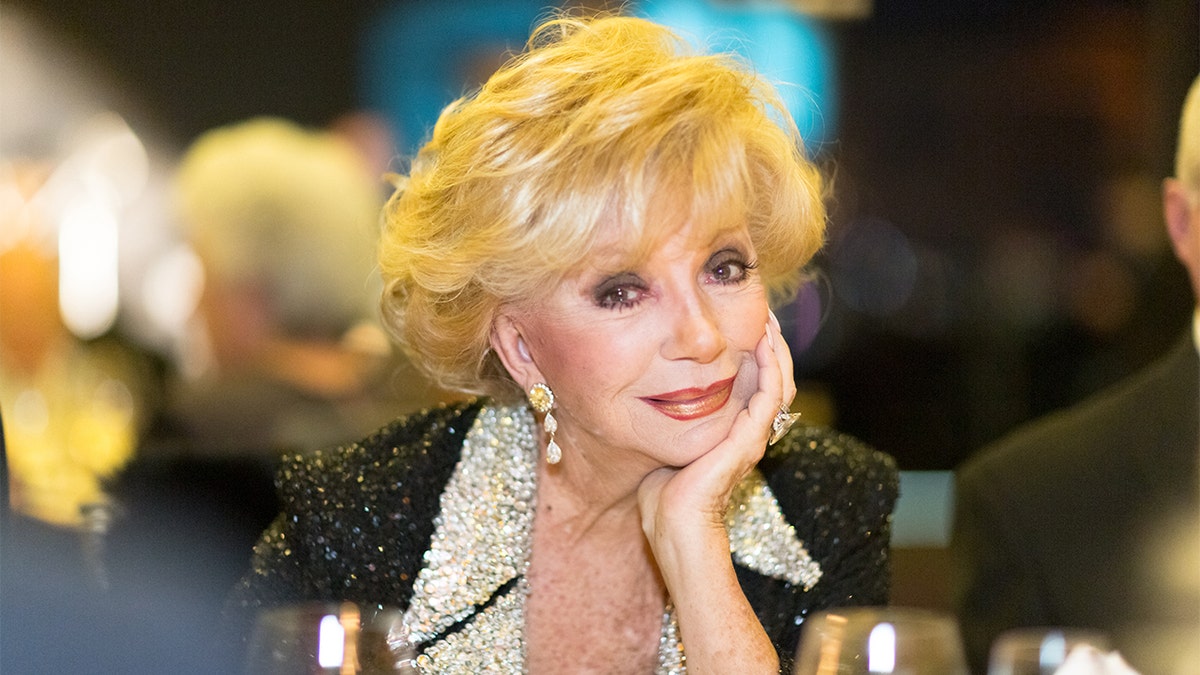
Before becoming the legend you are today, you started out as an usherette, candy girl, and eventually a cashier at Grauman's Chinese Theater. Could you tell us what happened that led to your being fired?
Well, Guido, like all young people, I wanted some money of my own that I didn't have to beg my father for. So I got a job during the summer months, when I was not in school, as an usherette. I got very lucky because I got the job at the premier theater in the country, Grauman's Chinese Theater, which is in so many Hollywood movies. Usherettes would stand with their flashlights at the top of the aisle and lead people to their seats when theaters were very crowded. And so I would be able to stand at the top of the aisle and watch all these wonderful movies from 20th Century Fox with Betty Grable, June Haver, Ethel Merman, and Mitzi Gaynor—all those wonderful leading ladies.
Did you see in them what you wanted to become yourself?
I would pray at the top of the aisle and say, "Oh, dear God, please let me do that someday." Well, the thing is, I did a good job as an usherette, but the candy girl got sick, so I got promoted to candy girl. Now, I have to explain, Guido, and to all your audience, that my mathematics was always lousy. But I could deal with the candy counter because everything was 10 cents, 15 cents, 25 cents. That was easy enough. I did a good job, and every time I wasn't selling candy, I'd scoot over to the top of the aisle and watch the girls singing and dancing. One night, the cashier in the box office out in front of the theater got sick, and I got promoted to cashier. And I said, "I can't do this. My mathematics is not good."
How did they convince you to take that position?
They said, "Don't worry about it. It's very easy. You just punch into the machine two at $1.98 or $3.25 or whatever it was. And then punch in how much you're given—$5 or $10—and it will give you the right change." Well, we were $40 short that night, and the manager thought I had taken it, so I got fired. And I sat there crying, with my chin quivering, saying, "You'll be sorry. One of these days, I'll come back and put my handprints and footprints in the cement in front of this theater. I didn't take the money." Well, a lot of years later, where did I get my star on the Hollywood Walk of Fame? The most prestigious location: right in front of the box office from which I got fired at Grauman's Chinese Theater. I loved it.

In film, you debuted in 1954 in one of the greatest musical classics, Seven Brides for Seven Brothers. Having appeared in only a few television programs by then, how did the opportunity to play a prominent role in such a major production come to you?
Well, I got a call from my brand-new agent at the time. I was thrilled to have an agent. And I was invited to come in for an audition because I thought of myself at the time as being a dancer. I was 16 or 17, very young. And so I went for the audition at MGM, and across the street from the casting office there was a big Catholic church. My mother, who had driven me to the studio, went into the church, dropped to her knees, lit candles, and prayed. I put on my little dance tights and went in for the dance audition. And the choreographer, Michael Kidd, had me do a little ballet and a little bit of jazz, and then they said, "Can you do something folksy?"
What did you come up with?
Well, I am of Lithuanian descent, and if there's one thing Lithuanians know, it's how to polka. I went in and polka'd up a storm, and I got the job. Now, I'm not sure whether it was my mother's prayers or my dancing, but thank you, God. And to this day, it remains my favorite movie in the world and holds up so well. Julie Newmar, who was Catwoman on television and everything else, was in it, and she's still very much alive. And so is Russ Tamblyn. He did not play my husband, but we were good friends and hung out together as kids growing up on that movie. It had one of the best dance sequences. You know, we rehearsed that barn-raising sequence for a good six weeks before we did it on the stage. That's a lot of work.
In 1957, you were part of that legendary plot twist in Witness for the Prosecution. What do you remember about the filming of those final scenes?
Well, I remember that I was in the reproduction that the studio did of Old Bailey, which is the name of the courthouse in London where all the major murder trials take place. They built it three-quarters to size, exactly the same as the original, so it was a marvelous experience to be in it and to be working with Tyrone Power, Charles Laughton, and Marlene Dietrich, plus that fabulous British cast that was working there. Now, do you want to know the fascinating story of how I got that movie?

Please share it with us.
I had been invited by a man that I knew who was a great host in Palm Springs, California, to join his party of maybe 10 or 12 people for the opening of Frank Sinatra at the Mocambo. The Mocambo was one of the big, beautiful nightclubs in Hollywood, and nightclubs were not doing well in the '50s because television had moved into every household and nobody was going out to these places. And the owner of the club prevailed upon Frank Sinatra to come in and help, and he said, "I'll come in and play for a week. Dean Martin will play for a week. Vic Damone will do the same. We'll all come in and see if we can get business started."
Had you ever gone to a Frank Sinatra concert before?
Well, I had never seen Frank Sinatra live on stage. I was too young to have seen him in his heyday in New York. But I did have all his recordings—his unrequited-love songs, which just broke your heart. I have to explain that the place was jammed. And Frank was working on a little dais about the size of your armspan in front of the stage. And the stage was filled with his orchestra. So there were people sitting behind Frank as well as in front of him. And I was sitting right under him, staring up at him. And if anybody has seen Frank Sinatra, you've got to know there was nobody ever more mesmerizing—before, during, or after Frank. Nobody ever could touch him.
What happened next?
A note came to my host asking whether he would mind bringing me over to meet this gentleman. So he took me over. And the man said, "Hello, my name is Arthur Hornblow Jr. I am producing a film called Witness for the Prosecution. And you, Miss Ruta Lee, have given a most unique screen test. I was sitting behind Frank, so I watched you watch Frank Sinatra. And I think you would be a very good love interest for Tyrone Power in my movie. Would you come in and meet Billy Wilder, our director?" And I said, "OK. Is tomorrow too soon?" (laughs) So I went in to meet Billy Wilder, and I got the film.

Do you have any memories of meeting Marlene Dietrich back then?
Well, at the time, Marlene Dietrich took a look at the little rushes they put me on. And she said, "Nein, forget it. She's blonde like me." I became a brunette overnight (laughs). And then, to work with Charles Laughton and his wife at the time, Elsa Lanchester, was such a blessing. He became a very good friend, and I had been warned that he did not like young girls, but just to do my business. He liked me very much. He taught me to play Scrabble, and along with his wife, he would have me come into their dressing room for lunch with them. It was an experience I will never forget. So I'm grateful to Frank Sinatra for singing the way he did, and to Arthur Hornblow Jr. for being seated where he was seated.
Talking about Frank Sinatra, in 1962 you were the female lead in Sergeants 3, the final film to feature all five stars of the Rat Pack. Which of them did you have the closest relationship with?
Look, the entire Rat Pack was such fun. And I was treated, unfortunately, not like one of their girlfriends, but as their baby sister. But, oh my God, nobody was ever as generous or as wonderful as Frank Sinatra. Yes, he would get miffed. If somebody walked up to him in a restaurant when he was trying to take a drink of his wine, put it down, and said, "Come take a picture," he would get mad. You know, anybody would. But he was great. Dean Martin was naturally, innately, the funniest man God put on this Earth. I mean, he partnered with Jerry Lewis, who was the funny man, but Dean's sense of humor and his confidence in who he was, and the fact that he did not take himself seriously, were such a delight.
What about Sammy Davis Jr.?
Sammy Davis Jr., of course, had more talent than the entire Rat Pack put together. He was just brilliant, and it was his job to walk me home from the lot, or wherever we were shooting that day. We were on location in Utah, in a place called Kanab, which was called Little Hollywood. And I was flown to work in a helicopter every morning to the mountains and the desert where we belonged. It was probably the most fun experience I could possibly have. My favorite, as you know, is Seven Brides for Seven Brothers because it was my first, and it was a learning lesson for me, but so was Kanab, Utah.

Do you have any anecdotes from your time filming that movie?
Frank made the arrangement with the studio, because he was one of the producers, that he would work a week in Vegas while we were shooting in Kanab, Utah, which was right around the corner—an hour away by flight. Dean would play the second week, Sammy would play the next week, Joey Bishop would play the next week, so we would go down for the opening, and we would go down for the closing. We would go down for the next opening and down for the closing. I spent more time on an airplane going back and forth than I did working, but, oh, what a great and lovely experience. And it's a great American joke. It's the American Western version of Gunga Din, you know, the Indian guy. I see it every once in a while, and I say, "That's Sammy Davis playing Gunga Din as an American soldier."
In 1963, you starred in the episode A Short Drink from a Certain Fountain of The Twilight Zone. Given that the show was so groundbreaking and ahead of its time for the science fiction genre, what was it like to be part of such a revolutionary series?
It was great fun for me because, to start with, it was shot at the MGM studios, where I had done Seven Brides for Seven Brothers and later Gaby and other stuff. So it was always fun to revisit MGM, you know, my first working lot. And wow, what a script that was. I was such a nasty little girl, and the bitches—please excuse me—are always much more fun to play than the nice girls. You know, right? So it was fun to play this bitchy little girl who was so mean to her older husband. And I'm not going to give away the plot, in case anybody hasn't seen it, but boy, does God take care of her (laughs).
How do you recall getting to know Rod Serling, the show's creator?
Mr. Serling was just a fabulous writer, and he was the kind of man I personally could have been very interested in, except for one thing. I mean, the man was handsome, he was young, he was flirtatious, he was brilliant, he was great fun to be with—but he smoked. Morning, noon, and night. A cigarette wasn't even finished yet, and he was already lighting the next one. And we would meet up on occasion if we were both in New York, and we'd have dinner together, but in those days everybody was smoking in restaurants. I blessed the day we stopped smoking on airplanes because then my nose stopped running. But what a lovely man he was.

Now talking about your personal life, in the mid-'60s, a truly extraordinary event took place when you contacted Soviet Premier Nikita Khrushchev and successfully secured a pardon for your grandmother, who had been held in a Siberian internment camp. Could you walk us through how that sequence of events unfolded?
It's a very long sequence. I'll try to minimize it. I was born in Montreal, Canada, and I didn't know my grandparents. I only knew about them through my mother. After the war, they lost contact—you know, there was no connection. She started during World War II trying to find my grandparents and discovered through the Red Cross that they had been shipped to Siberia. For what reason? Nobody ever knew. They were farm folk. They were rich because they had a cow—you know, that's the kind of farm people they were. They were deported in a cattle car, much like the trains that we see the Jewish community being deported to the labor camps, to Auschwitz or wherever.
What was it like for your family to endure those inhumane conditions in such freezing weather?
My grandfather and the men would huddle the women and the children together to try to keep them warm. And his legs were frozen. At one of the stops, when they took off his boots, the flesh went with them. Gangrene had set in, and he died. My grandmother didn't even know, because she was still in that cattle car, being shipped off, and she lived for 12 years in Siberia. In those 12 years, I, who was the first to become a citizen of the United States at age 16, when my mother and father decided to move to California and got a visa, started making up what the Russians called a vyzov.
What is a vyzov?
A vyzov is an invitation written in English, in Russian, and in Lithuanian. And basically I would write: "Dear Grandma, you are an old lady now. You're failing in health. I don't want you to be a burden to your family or to the state. I accept full responsibility and invite you to come to California, where the climate will be good for your health," and blah, blah, blah—you make up all kinds of things. And now this paper has to be stamped and notarized. The notary seal now has to be approved by the city of Los Angeles. Then this package gets sent to Sacramento, which is the state capital of California. That gets stamped. And now that has to go to Washington and get the State Department seal. Now these three pages are thick with ribbons and stamps. And you send it to Siberia.

What did they do with that in the Soviet Union?
The local commissar would take a look at it, stamp it with a "nyet," and six months later those papers would expire, and I would have to start again. I did that for 12 years. And finally, I got so tired of it. I went out with friends one night after we got a letter from my grandmother, who did not write—she never went to school—so one of her daughters was writing for her, a cousin of mine, thanking us for all the packages we had sent that sustained them and so on. And I'm crying because I didn't know anything. It took six weeks for letters to get to us. She could be dead, she could be alive—I don't know. And the more wine my friends poured that night at dinner, the more rational it became that I should do something interesting.
What occurred to you?
I was simply drunk enough to be nervy enough to pick up the phone and dial Moscow and ask to speak to Khrushchev. So I placed a call, person to person in those days, where you didn't pay for the call if you didn't get your party, but you paid twice as much if you did. The operator said, "How do you spell Khrushchev?" Well, who the hell knew how to spell Khrushchev? (laughs). Of course, they said "nyet, nyet, nyet," you can't talk to Khrushchev. And this went back and forth for like six or eight hours. And I was finally sobering up. In the meantime, I had been calling the Russian Embassy in Washington, trying to speak to somebody there: "Could I go to see my grandmother?"
How did you manage to overcome those institutional barriers?
Finally, the call came through from Moscow. They said, "Mr. Khrushchev does not speak English. You will speak with his interpreter." I remembered that he was a very handsome young man who traveled with Khrushchev. And when Khrushchev was banging his shoe on the podium at the UN, he was translating every rude thing that Khrushchev was saying and making it palatable for our American ears. And so I spoke to him, and he asked me what I needed. Nobody went to the satellite countries of Latvia, Estonia, Lithuania, Poland unless you were a high-ranking Communist Party member—you know, which I was not. But I said, "I want to come. And what's more, not only do I want to come, but I want to bring my mother and father."
 How much did it mean for your parents to go back to Lithuania?
Well, they had not been to Lithuania in 35 years, since they left. But I had been told by the State Department, "You could go, but your parents can't go because they were born and married there, and therefore they could be detained as Russian citizens," because Lithuania was under the Russian heel then. And I thought, "God will not be that unkind." And son of a gun, Khrushchev's interpreter said, "Call the Russian Embassy in half an hour and present yourself again." I thought, "Oh, here we go again. I'm going to get ‘nyet, nyet, nyet.'" This time, when I called back, I was connected immediately to the first secretary at the Embassy, who happened to be a Lithuanian, and I speak the language, of course.
What followed after that?
To cut this long story from getting any longer, within 48 hours we were all on a fabulous Pan Am flight to Moscow and then on to Lithuania. And a few months later, I was given permission again to take my grandmother out of Lithuania, by way of Siberia, back to California, where she lived for two years in glory and in the sunshine that God provided. You can read the full story in my book, Consider Your Ass Kissed. I'm sorry I don't have it in español, but I do have it in English. I'll practice my español, y'all practice your English (laughs).
On a lighter note, during the 1970s, you were a constant presence on television game shows, most notably on Hollywood Squares. What was your rapport like with the legendary host Peter Marshall?
A year ago now, I went to his funeral. He was well into his 90s, but then I'm 91, so it's no big deal. But he was always charming and naturally funny—a great singer, too. He starred on Broadway in a play called Skyscraper, and I went to see him, and he was wonderful. Nobody really knew that he sang so well. He often played the clubs around Palm Springs, where I have a home, and he and his beautiful wife were great friends. I went to their home for dinner often. They were great animal lovers; they had lots of dogs and kept adopting them to keep them off the streets. Everybody on the show had a great sense of humor, and I did it a lot. I was a regular on it.

What did you love the most about the format?
I loved the game shows and the talk shows here in California because the audience that watched them got to know the guest stars—in this case, I'm talking about me—personally. They got to know me as I am, as your audience is today. What you see is what you get. And so, either I was invited into somebody's living room or bedroom, because they liked me, or maybe they didn't. But it was always very good that people got to know each guest star by the way they behaved. Plus, I loved playing those games. Of course, it was also very interesting that, with the partner you were playing with, that line between love and hate was very small. If you were winning for them, they loved you, but if you lost money for them, everything went downhill (laughs).
In the late '90s, you played the girlfriend of Estelle Parsons' character on Roseanne. What does it mean to you to be recognized as an icon within the gay community?
Well, I've been an icon in the community because the gay world, especially in show business, is so prominent and dominant. And I'm so glad that nobody is saying, "Oh, how terrible." Some people still are, but we're all God's children. I don't care what religion you are, what sexual orientation you are, or what color you are. We're all here at God's will. And those of us who recognize that fact love and make room for each other. I live in Palm Springs, which is, I would say, 70% gay. And it's beautiful (laughs). Most of my friends are gay, and therefore I'm blessed because I get to laugh a hell of a lot. If there's one thing the gay community likes to do, it's laugh at themselves and at the world. And so I get to laugh along with them.
Well, you were recently part of RuPaul's Drag Race All Stars as a guest judge. What was it like to be rediscovered by a new generation of LGBT fans?
You know, it was absolutely extraordinary. First of all, being on the show is just great fun—all of it. But I got to do something quite special. I went backstage where the guys were. Well, when I say the guys, I mean the girls. They're the most beautiful girls, which really pissed me off because I thought, "They're prettier than I am." But I went backstage and sat with all of these gorgeous young men. And some of them are not gorgeous to begin with, but they know all the tricks of the trade and how to make themselves absolutely beautiful. But you know what? They're beautiful on the inside, which matters more than knowing how to put on makeup, eyelashes, and a wig.

Do you have any recollection of anything they said to you back then?
I sat with these guys, and some of them wept, and they had me in tears, talking about how important it was that people cared and people loved and didn't just look to be amused, but looked to share. And wow, it was a very touching, wonderful experience. And RuPaul is one of my dear friends. He is one of the handsomest men I have ever known, but boy, is he a beautiful woman (laughs).
Well, we've talked about film and television, but you've also had an extensive theater career, including The Unsinkable Molly Brown. Composer Meredith Willson famously said you were the best Molly of all time. What are your fondest memories of your time in that musical?
My experience with Molly Brown is one of my favorites. To start with, my best girlfriend while she was alive was Debbie Reynolds, who did the movie version of Molly Brown. And I opened in Fort Worth, Texas, at my favorite theater, Casa Mañana. And amazingly enough, I was hired for this by the director, who came to New York to meet me when I was on my way back from Lithuania, and had been following that like The Perils of Pauline. And he said to himself that any girl who was brave enough to face Khrushchev, go to the Soviet Union, take her grandmother out of Siberia, and bring her to the United States was indeed Molly Brown—she had the same guts and the same stamina.
Did you say yes right away?
He came over, and the money was not great. The role, of course, I knew was great. And he had to talk me into it because I thought, "Oh, I make 10 times that much money doing a show in Hollywood." But I have to tell you, it's one of the best experiences I've ever had. Having Meredith Willson say to the press that I was the best of all his Mollies, and that if I had been playing it on Broadway, it would still be running, tied me to the city of Fort Worth. The press fell in love with me. I fell in love with them. And therefore, with the whole city. It was a great relationship between the city of Fort Worth and Dallas, being next door, and a young actress, Molly Brown—otherwise known as Ruta Lee.

You serve as Chairwoman of the Board Emeritus at the Thalians, a charitable organization founded by Hollywood actors to champion mental health awareness. Having been there since the early days and looking back, what do you consider the organization's proudest milestone?
This all got started by a group of young Hollywood people, the Thalians. Thalia is a Greek goddess, a muse. She was the goddess of comedy, and she also took care of the straying lambs. So it seemed like a very appropriate title for people who decided to take on mental health as their cause to champion. And the Thalians, by having a big Hollywood spotlight shining on them, could shine that spotlight into that dark hole known as mental illness. And that's what we did. We put together an organization and built the first building by doing shows honoring a big star and having all kinds of celebrities come in and perform to raise money for mental health.
Who were some of these big celebrities you honored?
Some of our great stars were everybody from Frank Sinatra through Lucille Ball, through Whoopi Goldberg, and all the way through. And we've been doing it for 70 years. It's really quite amazing what we have accomplished. We decided to focus on children's mental health, and then, when we built the clinic, we expanded from working with children to working with older generations. But then someone came along and said, "Ruta, you're missing the boat on one thing. You are not doing anything for the returning veterans—those young men and women whom we send to every hellhole in the world. And sometimes they come back needing more than physical care. They need mental care, too."
How did you take care of that?
We joined up with UCLA and Operation Mend. Operation Mend heals the broken and damaged bodies. We Thalians try to heal the mind and spirit. And we're very grateful to everybody who has contributed $5 or $500,000 to us. Debbie Reynolds was one of our presidents, Donald O'Connor too, and Hugh O'Brien, a big cowboy star, was our first president. Lord knows I get tired, and when I do get tired, someone will come and tap me on the shoulder and say, "I've got to thank you for the help you gave my son, who was housed in your clinic." So God gives us two hands: one to help ourselves and one to help our neighbor. And I feel like we're doing that through the Thalians.

How have these past few years been for you, both personally and professionally? Are there any new projects on the horizon or perhaps a specific goal you still hope to achieve?
Well, I still hope to do a film with Clint Eastwood. That son of a gun has never hired me. We've been friends for so many years, and when I asked him to be the honoree at the Thalians, he did accept. It took me 20 years to get him, but I got him, and he was wonderful. I worked with him on his series when he was doing it, but I've never worked for him. So I still look forward to doing that. I still do my nightclub act. I still sing occasionally and sit on the piano and tell funny stories. Guido, I'll tell them about our conversation at the next one. Look, as I said, I'm 91 years old, so the good leading-lady roles are not there, and there are not that many great roles for somebody my age.
Could you elaborate on that?
What I mean is, I don't want to play little old ladies on crutches. I'm still blessed—I'm not sure if it's a blessing or a curse—there's high energy in me. But I'll still keep working. Maybe I'll come down to see you in Buenos Aires and sing and dance a little bit. I would be happy to be there; that's on my bucket list. I have friends who have been there several times, and they say the best food and the best people in the world are there, so I look forward to it.
You hosted a wonderful celebration for your 90th birthday last year. How did you go about putting together such a star-studded event?
Well, it was really very simple. I've called on stars all through these years—for the last 60 years—to come and be part of the show. And if people can, they will. And when I called and said that the only way I could imagine living through this birthday, since I don't like birthdays, was to ask, "Would you come and help me perform in front of an audience where we'll charge $90, since it's my 90th birthday, for a ticket to come in, and we'll raise money for the Thalians?", everybody agreed and came in, which was wonderful. And one of my people, one of my darling supporters of the Thalians—not a star, but a star in my mind—gave me $90,000 for my charity. Just incredible.

Earlier, you mentioned your memoir, Consider Your Ass Kissed. How did you come up with that title?
All through the years, when people have given me money for the Thalians, I would say from the stage to whoever it was—like this lady who gave me all this money, Madeline Gussman—"Oh, my darlings, please consider your ass kissed." Now, I said it so often, so many times, that my friend, George Pennacchio, who is the ABC television reporter, said, "Oh, my God, that is the greatest line. If you ever get this book finished, you should call it Consider Your Ass Kissed." So I did. It took me practically 10 years. And there are some places in the South where people still won't say "ass." And I always say, "If Jesus could ride into Jerusalem on his ass, I can kiss it" (laughs).
What can people expect from its content?
Consider Your Ass Kissed is a very honest book. What you see is what you get; what I write is what you get. It's a collection of little mentions of this and that—what brought me to Hollywood, how I fared in Hollywood, and how blessed I was to have all of you as my friends. And I am so grateful to anybody who goes to the theater to see me in a show, who turns on a television series because I'm on it, or who buys a ticket to one of my movies. What can I do but say, "Consider your ass kissed" (laughs).
To wrap things up, what final reflection or words of wisdom would you like to share with my readers?
I have no great words of wisdom. The only thing that really dawns on me is something that I said earlier. And it's a credo that I live by. And that is to remember that we are all God's children, every single one of us, no matter what or who we are. A smile is a very inexpensive way to brighten anybody's life. So you can give a smile or a laugh to anybody, whether it's someone in an elevator or someone sitting on the street who is just too poor to have a home. Give them a smile. Give them a moment. That's it. Amen.