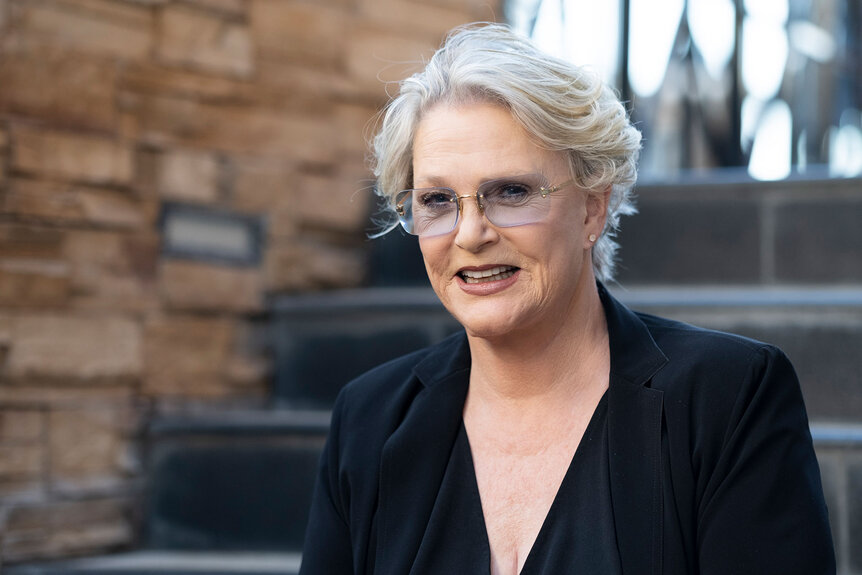
Your grandfather, Neil S. McCarthy, was a prominent attorney for major clients in the film industry, like Howard Hughes and Louis B. Mayer. How did he feel about you wanting to pursue a career in the entertainment industry?
Well, when I first told him I wanted to be an actress, he said, "You stay out of it. It's a filthy business." And I wanted to say, "Grandpa, that's how you made your money." But I didn't want to be rude. So I didn't follow that dream of mine for quite a while, because he had discouraged me from it. And I didn't really admit I wanted to be an actress until I told him again when I was 27 years old, which is very late in starting.
And what did he say then?
He said, "So you want to be an actress?" I said, "Yes, Grandpa." He asked me, "So what are you going to do about it?" (laughs) I replied, "Well, I'm going to take acting lessons. I've heard of this class." He said, "How much are they?" I told him they were like $300 or something. And he said, "So, you've got $300. Now what?" I mean, that was a lot of money to me, and he didn't throw his money around, you know. So I said, "Well, I have to find a night job because the class I want to take is on a Wednesday." He said, "So do you want to go home and get this career of yours?" I was visiting him in Arizona. I had told him I would come and visit him for two weeks. I thought it would be rude of me to arrive and then leave just because I got my $300.
How did things go after he said yes?
He said, "Have Mary get you a ticket." Mary was his new wife. And, as I was coming back to Los Angeles, flying over the city, I looked out of the window, and the thought of failure never occurred to me. I knew I wasn't a great beauty. I knew I didn't have a hot body. But I knew I had something and that I would make it. There was not a doubt in my mind. And when I got home, the phone rang, and it was a man saying he wanted to offer me a job. I said, "Well, Mr. Marks, I can't work for you because I'm going to be studying acting on Wednesdays. I have to get a night job." He said, "So I'm giving you Wednesdays off." I mean, Guido, come on. It's like God was listening, and just everything fell right into place.

Where did you work then?
I worked at a studio as a production assistant, and within a year of studying, I got a contract at Universal Studios. I was there for ten years, and I became the last contract player in the history of Hollywood.
Is it true that at the time a studio arranged a romantic date between you and a young Steven Spielberg?
Boy, you know everything (laughs). Yes, it is true. He had come back from doing a TV movie, and there was a big Hollywood event. I guess he wanted a date with some starlet; I don't know exactly what he wanted. But my picture was sent to 20th Century Fox, where they were arranging the date, and they picked my picture. He came and picked me up. It was sort of an awkward thing. He was a very nice man and told me how he used to sneak into Universal and take an office like it was his own. He sort of hid out in that office for quite a while before they discovered that he didn't really belong there. But we barely spoke to each other. He usually spoke to the producers and directors, and I spoke to other people at the table.
In the mid-70s, you landed your first prominent role in the memorable series Marcus Welby, M.D. You were supposed to be James Brolin's love interest, but I understand the chemistry wasn't as expected. What happened in that situation?
Brolin was very sexy, and they cut my hair off and gave me this new look, but there was no chemistry between us. None. And actors cannot explain or take credit for chemistry—absolutely cannot. Anyway, I got fired. It was fine; I should have been fired. And it had nothing really to do with him; I wasn't good in the role. So they hired some very sexy contract player with long hair, you know, the typical look in those days, and she played his love interest. I think in the show they get married or something. It was totally miscasting for me.

When your contract was terminated, Robert Wagner revitalized your career in a way by offering you the lead role in Switch. How did it feel to go from being almost out of work to starring in a series that would launch your career?
I wasn't getting very many jobs. They were still paying me at Universal, but I knew that if I didn't get this job with Robert Wagner, I was going to be out on the street—Universal let me know that. And the interesting thing is, the description of the character I went to read for was a Natalie Wood lookalike. Well, check it out (laughs)—I hardly looked like Natalie Wood, you know. But Robert Wagner knew what I looked like, and he still wanted to meet me. We just sort of hit it off. There was a sweet chemistry in the room that day I went to read. He was so kind to me, and he knew I was so shy. Just looking at him—I mean, it's Robert Wagner, for God's sake—I would blush and get so nervous. It amused him that I was so taken with him, I think.
Given that your appearance didn't fit the physique du rôle they were looking for, how did they take it?
I had a very, very short haircut at the time, and the producer said, "Well, I don't think she's right for it because she has to do undercover work for us. And that short hair..." And Robert Wagner said, "So? We'll get wigs for her. I like her." So I did a lot of undercover stuff with wigs and costumes. He saved my career. He taught me a great deal—taught me so much.
In what way?
He would make mistakes on purpose in a scene, and he'd come and whisper to me, "Do that funny look you do when you get angry with me. It's your close-up. Go ahead, do it." And I would say, "Oh, okay." So he would apologize to the crew for dropping a prop. He hadn't really dropped it—he did it just to talk to me. And he taught me that all the time. He said, "Now, listen. When you're through with this series, don't do guest spots anymore." I replied, "Why not?" He said, "Because you have a series now, and you'll get your next series, and you'll keep getting your own series. You see, you watch." I listened to what he said, and I stopped doing guest spots. Well, he was right, because I started getting my own series.

Well, talking about your own series, between 1982 and 1988, you played Christine Cagney in the hit show Cagney & Lacey. That role was also played by Loretta Swit in the TV movie and then by Meg Foster during the short first season. There's been a lot of talk about the reasons behind the casting change. What were the real reasons behind it?
I was offered the role first, and I turned it down because I had just done a pilot playing a cop with a male partner, and I just didn't want to keep packing a gun. You know, it just didn't appeal to me. So they offered it to Loretta, and she did the TV movie with Tyne Daly. Because it got good numbers, CBS decided to make it a series. But Loretta had to go back to M*A*S*H. So I was asked to do it again, but I was still under contract to Universal, and I couldn't do a series for anybody outside of Universal. They got Meg Foster, a wonderful, lovely actress. That show only lasted six episodes. And the problem, they say, was that even though Meg and Tyne are both wonderful actors, they were very similar. They needed a contrast between the two characters.
When they came to you for the third time, did you feel you could provide the contrast they were seeking?
Well, I was offered it again, and I said, "I want to see those six episodes because I may not be able to fix this, you know." And I could see the problem—I could see there was a great similarity in their approach: their attitudes, even their physicality, like they would both stand with their hands together. I mean, they didn't realize it, but everything was the same. And I remember watching Tyne. I thought, "Well, if she puts her hands across her chest, I'm going to put mine in my pocket." Anything to make us different and to add a little arrogance to Cagney, because I thought she needed that quality. And Tyne was very generous.
Could you share an example that illustrates that generosity?
Cagney was reckless; she didn't have children, and she didn't have a husband. She was a cop. And I asked Tyne, "When we're entering rooms with our guns drawn, do you mind if I go first?" Well, this was her third time playing Lacey, and she said, "Needless to say, I don't like the question, and I don't like the idea of it. But if you think that's good for the two of us, I will say yes to you." That's how generous an actress she is. It's a small thing, but it's a moment for Cagney, because Mary Beth had a family, and Cagney was a wonderful cop, but she was reckless. And I thought Mary Beth Lacey was not reckless—she had children to stay alive for. And when we did our first photo session, my manager called me over after about an hour of shooting and said, "The chemistry is palpable."

How would you describe your relationship, not only professionally but also personally, considering you're still friends to this day?
I'm very happy to tell you that when we were shooting all those years, we didn't have time to be friends; we didn't have time to hang out. We were together constantly, 24 hours a day. And after we would shoot, we would go into my trailer and learn the next day's lines. So we didn't have time to really be pals. But now that we're not doing this series, we're very close friends. We talk on the phone at least two or three times a week. Whenever I'm in Los Angeles, I call her, and we have dinner—very close.
What's your favorite storyline or something that stands out to you from your time on the show?
Well, there are a couple of moments I enjoyed. We hardly ever got to do comedy, but we were kind of funny. We did a cooking scene—we called it Lucy and Ethel—and it was a comedy scene where I was helping her, very selfishly. It was all about Cagney, right? Forcing her to cook for our boss for dinner, honoring him. And we really had fun with that—threw flour in each other's faces. I mean, it was a real all-out comedy scene, which people weren't used to seeing us in. But I think my favorite material that I had was when they finally admitted that Cagney was a drunk; she was always drinking.
How did you handle such a sensitive topic?
My producer, Barney Rosenzweig, said, "Do you want to deal with this? Because you've always got a drink in your hand." And some reporter said, "You know, Cagney has all the attributes of the adult child of an alcoholic." Well, Charlie Cagney, her father, who was also a cop, was a raging alcoholic—and he died of it. He died falling down and cracking his head. So they did a two-parter addressing the seriousness of it with Cagney. And because I was used to doing, you know, light stuff, that was very heavy-duty material—but I enjoyed it. The crew and Tyne were behind me. One of my Emmys, I won for that.

I understand that this storyline paralleled a problem of alcoholism in your own life. How did you face it?
It was my agent—who I used to go out and drink with and have a good time with—who called me on it. He said, "I never see you without a drink in your hand anymore." And so he sent me to Hazleton to stop drinking, which I did. I didn't want to—who wants to? Who wants to stop drinking? But anyway, I did, and I've been sober, I'd say, for at least 20 years.
You continued your success with The Trials of Rosie O'Neill, which was also produced by your now-husband Barney, in the early '90s. What was the funny anecdote related to your "special" bra?
Oh, I know the story you're talking about. I'd lost a lot of weight—I'd gotten very thin on The Trials of Rosie O'Neill—and Barney came into my wardrobe fitting. I guess I was there in a bra and pants or something, but we were together by then, so, you know, he didn't have to knock to come into the dressing room. And he was telling them, "I want her to wear this, I want this look for her. And about her bra, get her something more aerodynamically sound." (laughs) That was his expression—something that, I guess, lifted me up a little because I'd lost so much weight.
Soon after, you became the first person to portray Annie Wilkes onstage in the West End production of Misery, adapted from Stephen King's novel by Simon Moore. Had you seen Kathy Bates' performance in the 1990 film?
I had. Kathy had done the movie first, and then the West End of London called me and said, "We want to do this on stage. Would you come and do it?" Well, I had very little stage experience, so I was thinking, "Oh, my God." But I was in menopause, so I said, "I'm ready for this role." (laughs) So I got on a plane and went to portray Annie Wilkes in the West End. The movie was soft compared to Stephen King's novel. On stage, we did exactly what Stephen King wrote, so it was very violent. Just doing a production like that in the West End is horrifying—it ain't Shakespeare. But it was a big success, and I worked with a wonderful British actor named Bill Patterson. In our version, it was just a two-hander: the nurse and the writer.

Big projects didn't end there for you, because between 2000 and 2005, you starred in the LGBT-themed show Queer as Folk. Your lesbian kiss with Rosie O'Donnell sparked a lot of attention, and I understand it even made you kind of question your own sexual orientation. How would you describe that period?
Oh, well, not really. Rosie and I became very close, and I developed a schoolgirl crush on her. I was such a fan, and I told her one night, "You know, this is really weird, but I love you so much. Do you think...?" She said, "Oh, Glessy, you're so straight." (laughs) And I thought, "Really?" She said, "Oh, yes, please. Thank you, but not you." And so that was the end of that. I loved her so much that I just needed to tell her about my feelings, and I misunderstood my own feelings. I still love her like that.
How do you feel about being considered a gay icon?
Oh, I love it. I'm very proud. That changed my career again. I've been so blessed, Guido: all these series that made a difference. But I went after that role. Somebody sneaked me the script, and I called up Showtime, the network that was making it. I told them I wanted it. And the head of the network said, "Oh, Sharon, you don't want this role. There's no money in it, and it's out of the country..." I said, "I don't care." And they said, "Well, if we fly you in, would you meet with our producers?" I said, "Of course I would." I was in a play in Chicago, so they flew me into Los Angeles to meet the producers. And it was a love affair from day one. Robert Wagner was right: keep doing series, because each one of them would change my life.
What about Burn Notice in the late 2000s and early 2010s? What was your experience like?
I live in Miami, and that's where we shot it, but I was in Los Angeles when they sent me the pilot script. So I said, "Okay, I'll do it." And I flew to Miami, not telling them I lived here because I wanted to hang out with the other actors and I wanted per diem. So they never knew I lived here. I shot it and went about my life. And then, I don't know, like months later, they called and said, "Burn Notice sold." I said, "What's Burn Notice?" It had been so long. My manager told me it was the pilot I had done in Miami. I said, "Oh, my God. I have to tell them now I live here." (laughs) Because obviously they needed to deliver my scripts to my home. And it changed my life again. Jeffrey Donovan is still my boy, and he calls me mom to this day.

Outside of your professional career, a surprising event took place in 1990, when an obsessed fan broke into one of your properties with a rifle and barricaded herself inside for hours. How do you remember that traumatic experience?
I don't usually talk about it. I don't think I discussed it in my book, or if I did, I didn't use her name because I don't want to upset her family. But I wasn't in the house when she entered—thank God. She was a fan of Cagney & Lacey. I mean, the SWAT team had to come in. They flew someone in by helicopter to break into my home and try to get her out. I watched the whole thing on TV that night, on KTLA. And I was very blessed—nobody was hurt. I called the police and asked them if they wanted me to come over. They said, "No, stay away." So, anyway, I was spared a terrible fate.
What do you think lay at the root of her obsession?
You know, Guido, television is much more powerful than motion pictures—much more powerful. It always has been, because people watch you in their homes late at night; they sit in the bedroom and they watch you. It's different with movies. Television is very intimate, and that's usually where unfortunate things happen.
On a lighter note, talking about fans and going back in time, Cagney & Lacey was cancelled for a second time after you starred in the second season, and then the public's outcry led to its return to television, eventually becoming a very popular show. How much do you think the strong support from the female audience impacted the show's rising ratings?
I think it was everything. The idea came from Barney Rosenzweig, who was the executive producer of Cagney & Lacey. He called me and said, "Are you getting any fan mail?" And I told him, "Yeah, quite a bit." He said, "Well, Tyne said she is too. May I have all of it?" And I replied, "Sure." So he sent a car to Tyne's house and mine. He answered every single fan mail. It was a form letter, for which he apologized, but he told everybody who wrote, "Writing to me isn't going to help. But if each one of you writes your local newspaper and your local affiliate station, that may help. Don't write to CBS because they never read their mail." And everybody did. There was a deluge of letters.

Where did all those letters end up?
The affiliate stations and all the newspapers around the United States didn't know what to do with all of them, so they sent everything en masse to CBS. CBS saw the impact and brought us back, and we became the highest-paid women in television.
What projects do you have on the horizon?
Nothing at the moment. I finished narrating a book. I narrated my own book as well, which got nominated for an Audie Award, and I just finished another one for a documentary. I realized that's what I love to do—I love using my voice. I don't know. It's not that I've retired, but the jobs don't come to me as often as they used to. I'm 82 now. But I love using my voice, and that's what I put the word out—that I really enjoy narrating.
And what are you looking forward to in your personal life?
Good question. Just to be satisfied, to pursue the friendships I have, you know. My big dream—and this sounds so boring—is to clean out every closet I own, every drawer. I want to clean it all out, give stuff away, and start over. I know it sounds boring, but it isn't. The things you can find? Oh, my God.
Last but not least, is there a message you want to give to my readers?
Well, I don't know if they're fans of mine, but if they are, thank you for their support.